Mullite‑Rich Calcined Kaolin in Refractory Cements: Strength and Service Life
In Asian high‑temperature operations—steel, cement, glass, non‑ferrous, power—the real performance of a lining is decided not by catalogue values, but by its phase assemblage, pore architecture and response to thermal cycling. Mullite‑rich, mullite‑forming calcined kaolin has emerged as a reliable aluminosilicate raw material for raising the strength, dimensional stability and durability of refractory cement‑based monolithic and shapes.
What Defines a Mullite‑Rich Calcined Kaolin?
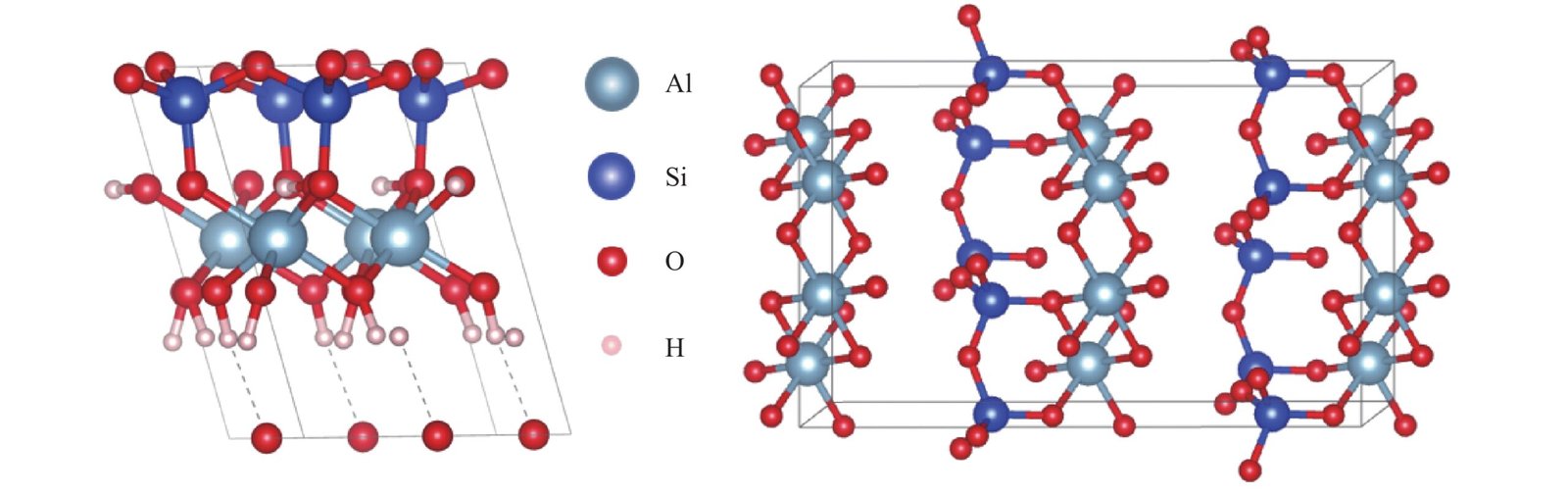
Starting from selected kaolinitic clays, controlled high‑temperature firing converts the layered aluminosilicate into a mullite‑dominated microstructure with a tuned alumina–silica ratio. A well‑designed product typically exhibits:
- Mullite needles/prisms as the primary crystalline phase
- Residual cristobalite/quartz in limited, controlled amounts
- A restrained glassy phase that aids sintering but does not promote creep
Grain size and morphology are adjusted so that the material integrates cleanly into low‑cement and ultra‑low‑cement constables, ramming masses and mortars without destabilising the overall granulometry.
Mullite Formation: From Kaolinite to a Load‑Bearing Skeleton
The key performance advantage lies in how mullite is generated from kaolinite.
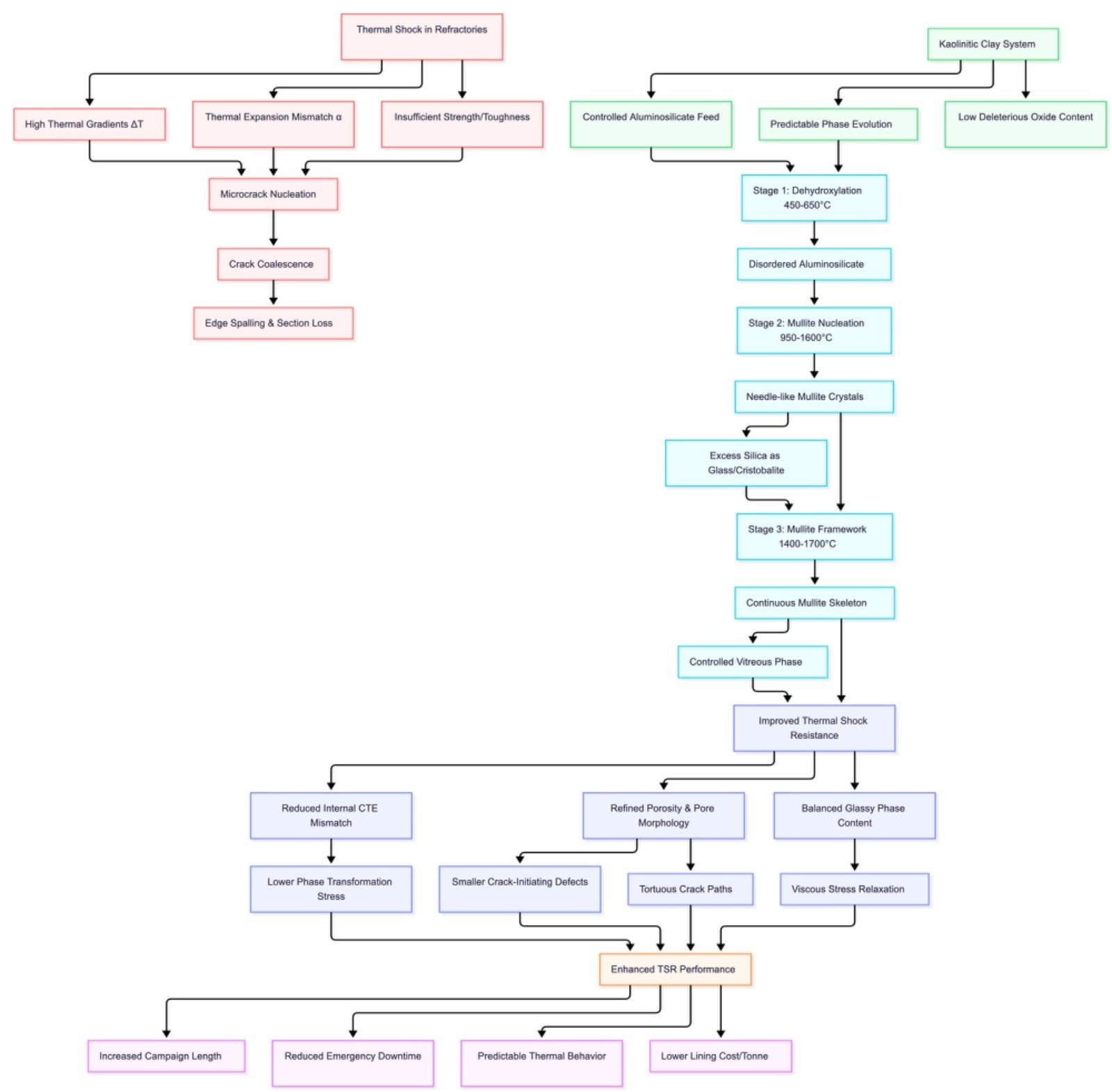
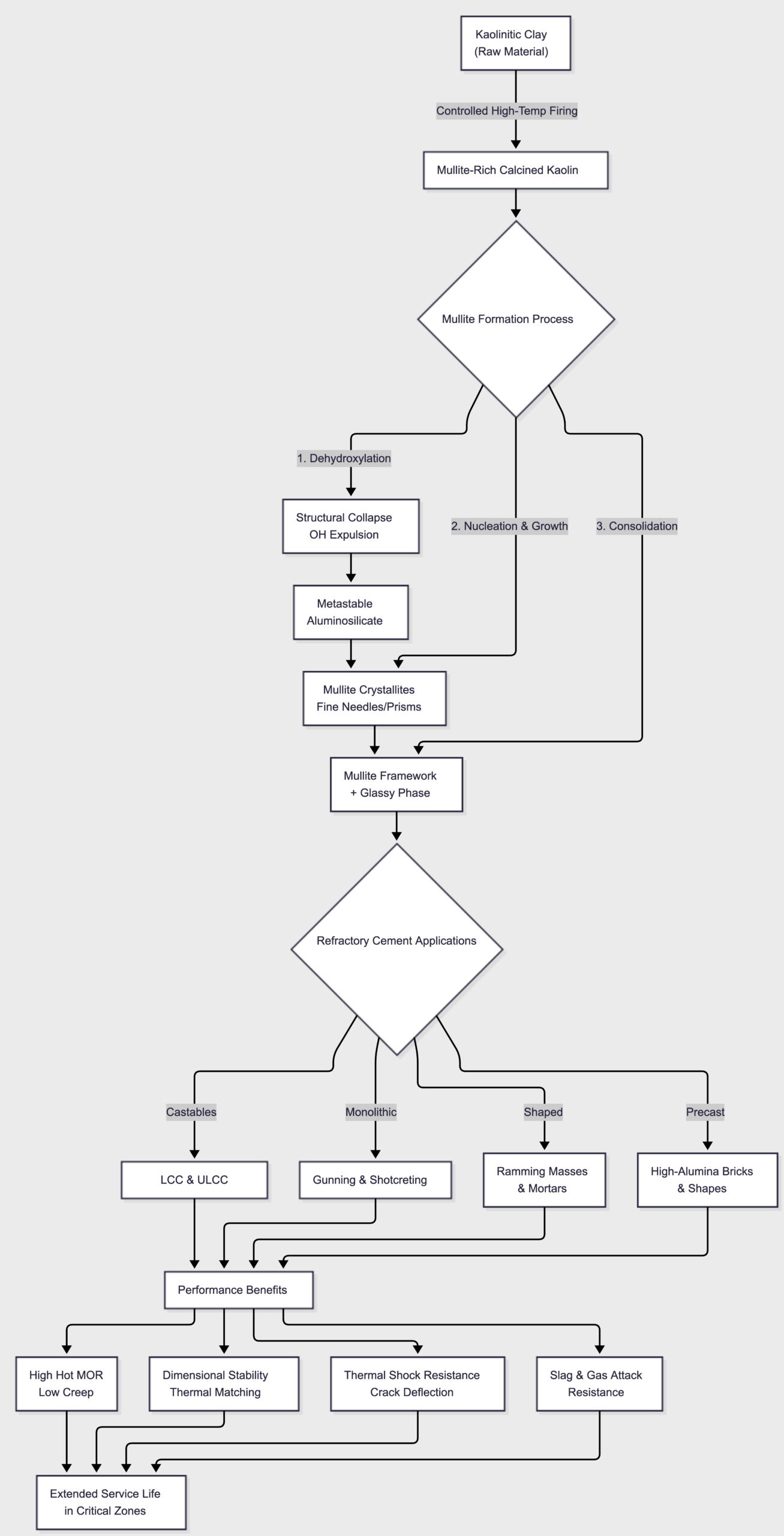
- Dehydroxylation and structural collapse At intermediate temperatures, kaolinite expels structural OH groups and the ordered layered lattice breaks down into a disordered aluminosilicate. This metastable framework is the platform for subsequent mullite nucleation.
- Nucleation and growth of mullite With higher firing temperatures and sufficient soak, alumina‑rich regions reorganise into mullite crystallites. These grow into fine needles or short prisms, while excess silica segregates into intergranular glass and/or cristobalite. The resulting mullite population—size, aspect ratio, distribution—is controlled via temperature, hold time and raw‑mix chemistry (including Fe₂O₃, TiO₂ and alkalis).
- Consolidation of a mullite‑dominated framework At the target firing regime, the material develops an interlocking mullite framework supported by a thin glassy film and minor silica phases. The glassy phase is kept just high enough to promote neck formation and densification, yet low enough to maintain good refractoriness under load and limited viscous deformation. The outcome is a pre‑engineered mullite skeleton with a refined pore structure and stable phase composition.
Because this mullite network is created under controlled kiln conditions rather than inside the lining during service, the refractory cement system starts with a known mullite backbone. That reduces uncertainties during first heat‑up and avoids large volume changes tied to in‑service phase transformations.

How It Improves Strength in Refractory Cement Systems
High‑temperature mechanical function
Mullite combines high refractoriness under load, low creep and a favourable hot modulus of rupture. In a castable or mortar matrix, a mullite‑rich calcined kaolin:
- Provides a stiff load‑bearing skeleton at operating temperatures
- Restrains permanent linear change and distortion under mechanical and thermal load
- Helps the lining maintain integrity over long campaigns and in critical hot zones
This is particularly important in high‑alumina refractory solutions where mullite is a deliberate target phase for the hot face.
Packing, porosity and crack initiation sites
On the microstructural side, a well‑graded mullite‑bearing fine fraction improves particle packing:
- Fines occupy voids between coarser alumina, bauxite and chamotte grains
- Both total open porosity and pore connectivity are reduced
- The frequency of large, isolated pores—typical crack initiators—is lowered
The result is a denser, more uniform microstructure, reflected in higher cold crushing strength, improved HMOR and better abrasion resistance, from installation through steady‑state operation.
Thermal Behaviour and Dimensional Stability
A mullite‑rich calcined kaolin has a direct influence on how the lining responds to temperature.
- Refractoriness and creep resistance : Limited glassy phase and a continuous mullite network suppress high‑temperature creep and softening.
- Thermal expansion matching : By selecting the right mullite content and grain size, the thermal expansion behaviour of the matrix can be better aligned with coarse aggregates, reducing internal mismatch stresses.
- Phase stability : Since the principal high‑temperature phase is already present, the lining is less dependent on in‑service mullitisation, giving more stable properties across the operating range.
These features are particularly relevant in cyclic duty and areas with strong temperature gradients and frequent start‑up/shutdown.
Durability: Thermal Shock, Chemical Attack and Microcracking
Response to thermal cycling
Thermal shock resistance depends on both intrinsic material behaviour and microstructural architecture. Mullite‑rich calcined kaolin supports this by:
- Limiting the size and connectivity of pores where thermal stresses concentrate
- Providing mullite grains and phase boundaries that deflect and blunt growing cracks
- Allowing linings to withstand rapid temperature changes with reduced spalling and edge chipping
Behaviour under slag and gas attack
In contact with slags and aggressive atmospheres, a mullite‑dominated structure offers:
- Lower silica activity and higher alumina content, reducing dissolution rates in many basic and acidic slags
- Restricted penetration of melts due to modest glassy phase and a tight pore network
- A coherent hot‑face microstructure that erodes more slowly and more uniformly
This supports longer lining life in slag line, metal line, burner and transition zones, where wear mechanisms are most severe.
Practical Use in Refractory Cement‑Based Systems
In practice, mullite‑rich calcined kaolin is typically used as:
- A fine aluminosilicate component in LCC and ULCC castables
- A matrix‑level raw material in gunning and shotcreting mixes
- A constituent of ramming masses and mortars for tundish, ladle, kiln and boiler linings
- Part of the aggregate/matrix blend in high‑alumina bricks and precast shapes
- A strength‑supporting component in lightweight and semi‑insulating refractories
In all cases, it is selected for phase compatibility with high‑alumina systems and for its ability to promote a mullite‑dominated, low‑porosity microstructure after firing.
Next Steps for Formulators and Plant Engineers
If you are reviewing raw material options for castables, mortars, ramming masses or high‑alumina shapes, you may wish to evaluate a mullite‑rich calcined kaolin grade against your current aluminosilicate component. A straightforward approach is to run comparative lab trials for RUL, CCS, HMOR, PLC and thermal shock, followed by a limited line trial in a representative critical zone.
For application‑specific data on the mullite‑rich calcined kaolin grades supplied by Patel Nagar Refractories Private Limited—phase composition, PSD, typical test results and recommended addition levels—please contact Patel Nagar Refractories Private Limited via the Contact section of our website so that we can share technical details aligned to your service conditions.